Arcade at 50 years
Arcade at 50: from small steps to pinnacle projects – how a family business became the heart and lungs behind every project
2025 marks 50 years of Arcade – five decades of engineering solutions that power buildings, protect environments, and push boundaries. In this special four-part feature series, we revisit the milestones, turning points and lessons that have nurtured 50 years of success and shaped who we are today.
From Luton’s printing presses to a family legacy: the birth of Arcade
Our story started on the printing presses of Luton in 1975. Our founder and Chairman, Chris West, began in the plumbing and heating trade for his company, Beds and Herts, taking on pipework jobs on the presses in the local area. The quality of his work was soon recognised and the business picked up jobs across the country.
The jobs kept coming and so did Chris’ knack for spotting and seizing opportunities. Printing presses were crucial to 1970s Britain. With no internet and few alternative routes to news, people relied on newspapers and magazines to stay informed.
Keeping the presses running was dirty, laborious and noisy work. To cut the noise, Chris fitted sound enclosures. This made the presses hot, so the solution was to install air conditioning. These were the first steps of our specialisms starting to form, and the family ethos of seeing a gap and finding a fix came to the fore.
As print technology advanced, so did Chris’s service offer. Providing full temperature control, he incorporated process cooling, gas pipework, compressed air, ventilation and water treatment - becoming staples of what we would deliver in the future.
As the scope of work grew, the name Beds and Herts felt limiting. Inspired by company who advertised regularly in the Sunday Times Magazine, Chris re-named his business Arcade. It was from this point that we started our half a century journey from small business to a globally trusted mechanical and electrical contractor.
Print lines to bloodlines: Building a trusted M&E business with family at the core
Through the 1980s and 1990s, print boomed and main sheet feed presses were eventually overtaken by web‑offset machines. Designed for high-volume printing on a continuous roll of paper (a “web”) rather than individual sheets, these machines required the ink to be baked on in an oven, with the paper then needing intensive cooling. This played to our strengths and was exactly the kind of mechanical and pipework problem they were set up to solve.
During the print peak era of the 1990s, Chris’ son Mike West stepped on board on a trial basis. Initially unsure whether it would work, Chris soon saw that family involvement came naturally. Mike joined as a 16-year-old, working on the tools, before making the move full-time after university towards the end of the decade. Before long, he was managing jobs and clients before bringing in cousins Sam and Joss Williams.
Sam joined in 2000 as a pipefitter’s mate, progressing over time to a pipefitter, foreman, and project manager. Sam’s brother Joss joined, a year later, taking a role in project management.
Progression is an area that we pride ourselves on. Not just in the day-to-day, but how we support our people. There is no better example than the family itself.
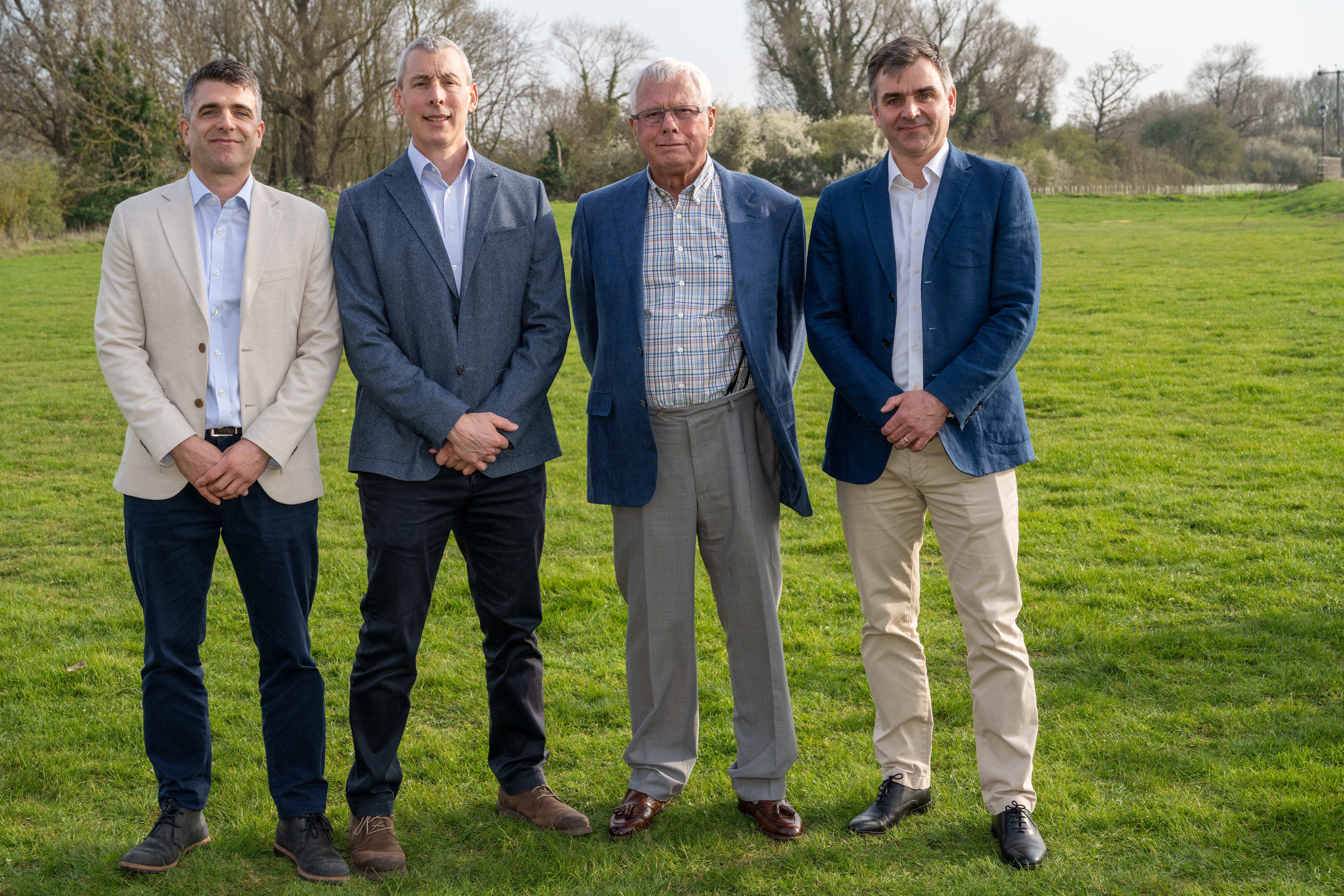
We are now run by the four family members. Chris as initial founder and now chairman, Mike becoming Managing Director, Sam progressing to Project Director in 2012, and Joss moving into the role of Director of Building Services. Each brings different experiences but shares the same focus.
It is not just the West’s and the Williams’ that have grown with the business, many others have too, projecting a family feel across the organisation.
Mike celebrates Arcade as a great place to work and one that invests in and rewards our people. Both Sam and Joss say that professional advancement is a two-way process: “One of the things we tell a lot of people is that there’s opportunity here - as long as they have a good work ethic and want to progress themselves.”
Alongside progression at board level, other staff promotions include an admin assistant becoming Office Manager and a gas engineer who went on to lead the service department. In the last year, six employees have been promoted across the business.
We are also encouraging the next generation - but not necessarily other parts of the family just yet. 14 apprentices are currently on board and we have partnered with BESA Group’s Seed Programme to promote our business and raise awareness of engineering careers in schools and universities.
Sam adds: “I think the scale of what we do often surprises people. We say that many don’t realise that M&E is the heart and lungs of every building. You don’t notice it when it’s working but you notice everything when it isn’t.
“We also give the example of the scale of ventilation booths for offshore monopiles – these can be 125 metres long, 20 metres high and 20 metres wide - ductwork you could walk down. It really lands the ‘behind everything’ message.”
A mantra which all four repeat is that performance leads to trust, and trust leads to responsibility. That was never truer than what happened midway through the first decade of the new millennium, when the next step not only changed their careers but would also shaped Arcade’s trajectory.
The landmark projects and engineering innovation that made Arcade
For almost 30 years our focus was on the printing presses. It was a sector where we excelled – taking on around 10 installations in the UK each year and serving up to 300 customers. As time moved on and improvements in technology rose rapidly, demand for paper publications dwindled.
The pivot into other sectors began with a recommendation from a trusted long‑standing supplier relationship. After years of chiller work with Carrier HVAC on their printing presses, we became one of their preferred partners. So, when a world-renowned department store needed to replace their basement chillers, it was Carrier who made the revolutionary introduction. This was the turning point. From a small business founded in Luton working on the printing presses, this SME was now responsible for providing temperature control for one of the most well-known names in retail. As was seen in the initial years, one job always led to another. What began as replacing a pair of chillers in the basement, doubled to four, and then became a four-year re-plant of the entire roof on their Grade II listed building in central London. The pressure was unrelenting, but the business coped and learned how to manage jobs on that scale.
As Joss describes, “It really transformed the company because we started work working under contracts and workers. We were the principal contractor on that job.”
Not that it was all plain sailing. For example, every middle-of-the-night storm would cause concern. Sam recalls a night thinking about the Knightsbridge roof: “Part of the programme meant lifting the roof membrane, doing the works, and then reinstating it. You’d wake in the night, hear the rain and think, ‘oh no’, then get to site and circle where the water had found a way in.”
Joss added: “We learned a lot in that job, it taught us how to structure jobs properly, and how to take on jobs of that commercial size.”
From princes of the printing press world to a principal contractor on a high‑stakes, high‑visibility contract multimillion pound contract, this project remains a standout and built our confidence to go further and apply our skills in other fields.
Through the Science and Technology Facilities Council, we discovered new opportunities, including a route into CERN . At a time when the UK’s contribution to CERN’s budget created a strong pull to place work with British contractors, we used our expertise from the printing presses to deliver cooling‑pump replacements for the Large Hadron Collider. We undertook ventilation works on ATLAS and installed close‑control systems for a CMS laboratory. Mike recalls these projects as “prestigious”, and while complex, have created lasting pride in overcoming technical challenges.
Then came more high-profile work at Cranfield University. There, the team helped build a supersonic test rig capable of Mach 3 airflow, funded by the Government agency, the Defence Science and Technology Laboratory (Dstl) for engine research. Another high-risk project involved taking jet fuel, heating it to create stresses for the engine fuel pump, and then cooling it down to try and create icing. These jobs demanded exacting standards of safety and precision, but to Mike these were “all very exciting”
Alongside specialist industrial and science work, our expertise now spans multiple sectors, working with businesses all over the UK. Our focus includes installations in building services, archive storage rooms, environmental control, process engineering solutions and heat recovery and decarbonization. We offer the latest thinking and design best practice solutions.
Under Joss’s care, building services has become our major growth line, one that he calls his “baby.” Championing the Arcade ethos, he saw a gap in the market and built a solution.
With decarbonisation high on many agendas, heat recovery is a strong indicator of expansion. Installing systems that reuse waste heat generated by production processes helps reduce energy costs and can be converted into hot water for use elsewhere.
Half a century of Arcade - lessons, values and the road ahead
50 years in business will always create peaks and troughs but even through the hard times there is always a solution.
Sam recalls a job in Germany during COVID while managing the aftereffects of Brexit. He describes the experience as “a nightmare” and “feeling the weight of the world on my shoulders”. By not panicking and talking it through, all targets were met, the job finished on time, and every barrier was navigated. It is also a project that Mike is very proud of and one that for Sam provided considerable perspective. “The job felt crushing at the time but then I caught a radio clip from a war-torn situation and thought, I’ve got no problems whatsoever… get back and get on with the work. I’ve always carried that moment with me.”
For Chris, one of his best wins was the sense of feeling of snatching back a major half-million-pound contract when all looked lost, by proving that a competitor’s offer was inadequate.
While there are some stories that always stick. Unfortunately for Joss, one concerned him stripping out ink pipes on a printing press: “I would go home and have ink in my hair and ink in every part of my body.” Sam chipped in that unfortunately his brother had cut into an ink pipe. “It jetted out, spraying his face with yellow ink and he came out looking like a Minion!”
From printing presses to ground-breaking physics and everything in between, our principles have remained the same. While the world looks very different over half a century on, Chris is steadfast in his view of what creates success: “Earn trust, be responsive and your clients stay”. The same is true of employees. As Mike says: “We’ve become the place where people want to work. We want to be inspirational.”
Our reputation continues to build, and our values that have remained a constant thread through our first fifty years, will hopefully guide the next fifty too.
As a man who has overseen Arcade’s journey since 1975, it is fitting to leave the last few words to Chris: “In this day and age, where everyone's shopping around to get the best price, there's always someone cheaper, but not always someone better.”
When asked what his greatest achievement at Arcade has been, “Making it to 50 years” he says. And of the team he’s developed: “I'm proud of them all.”
